 | • レポートコード:IMA3299JU7731 • 出版社/出版日:IMARC / 2026年2月 • レポート形態:英語、PDF、約120ページ • 納品方法:Eメール(納期:3日) • 産業分類:産業装置 |
| Single User(1名様閲覧用) | ¥623,844 (USD3,999) | ▷ お問い合わせ |
| Five User(5名様閲覧用) | ¥779,844 (USD4,999) | ▷ お問い合わせ |
| Corporate User(閲覧人数無制限) | ¥935,844 (USD5,999) | ▷ お問い合わせ |
• お支払方法:銀行振込(納品後、ご請求書送付)
レポート概要
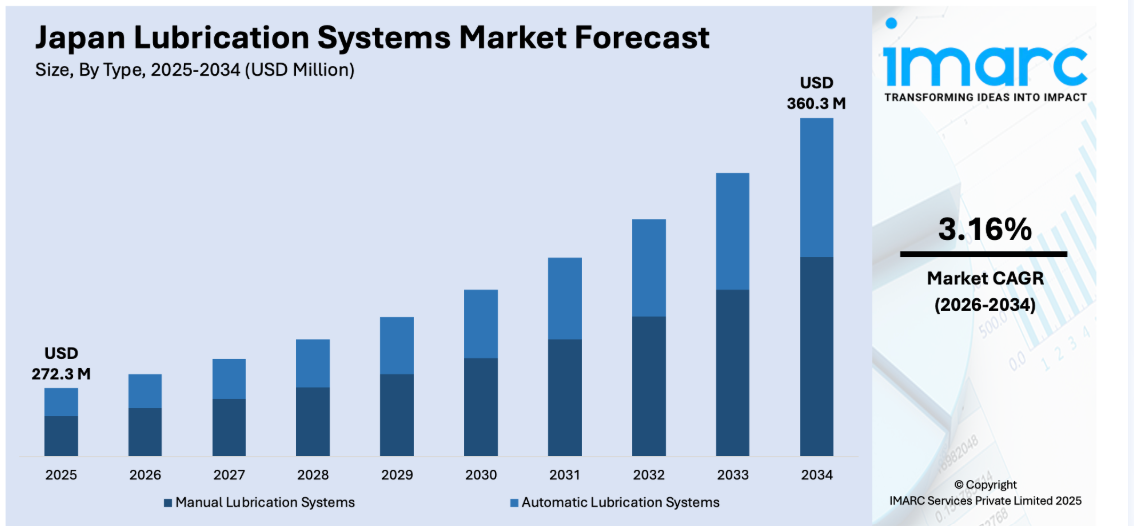
| 日本の潤滑システム市場規模は、2億7,230万米ドルに達しました(2025年)。今後について、IMARC Groupは、同市場が3億6,030万米ドルに達すると予測しており(2034年)、2026年から2034年にかけて年平均成長率(CAGR)3.16%で成長すると見込まれています。この市場の成長を牽引しているのは、同国の先進的な製造業、高い自動化水準、そして精密工学への重視である。自動車、ロボット工学、エレクトロニクスなどの産業は、性能向上とメンテナンスによるダウンタイムの削減のために、効率的な潤滑ソリューションに大きく依存している。持続可能性への取り組みの拡大や技術革新も、日本の潤滑システム市場のシェア拡大をさらに後押ししている。 日本の潤滑システム市場の動向: 先進製造と産業オートメーション 先端製造および産業オートメーションにおける世界的なリーダーとしての日本の地位は、同国の潤滑システム市場の主要な推進要因となっている。日本の自動車、エレクトロニクス、精密機械の各セクターでは、連続稼働を確保し、重要部品の摩耗を低減するために、高効率で信頼性が高く、自動化された潤滑ソリューションが求められている。生産システムにおけるロボット技術と高速機械の導入は、集中型かつ自動化された潤滑システムの導入を必要としている。これらのシステムは、生産性の向上に加え、メンテナンス費用の削減や精度性能の向上をもたらし、日本の高生産性産業の要件に合致している。運用効率への注力と、メーカーによる稼働時間の確保という要件が相まって、日本の産業・技術基準を満たす最先端の潤滑システムに対する安定した市場需要が生まれている。 機械の寿命延長と効率性への重視 日本の産業界は、機械の寿命延長と運用効率の最適化を非常に重視しており、これが効果的な潤滑システムへの需要を後押ししています。定期的かつ精密な潤滑は、機械部品の摩擦、摩耗、およびエネルギー消費を低減するために不可欠です。設備の信頼性が最優先される自動車や航空宇宙などの分野では、潤滑システムが性能を維持しつつ、予期せぬダウンタイムや高額な修理費用を最小限に抑えるのに役立ちます。この予防保全への注力は、綿密な品質管理と生産効率を重んじる日本の文化と合致しています。さらに、企業は予知保全戦略をますます採用しており、潤滑システムと監視技術をさらに統合して設備の状態を最適化することで、最終的には日本の潤滑システム市場の成長を支えている。 環境規制と持続可能性の目標 日本の厳しい環境規制と持続可能な産業慣行への取り組みは、企業に環境に優しくエネルギー効率の高い潤滑システムの導入を促している。これらのシステムは、廃油の削減、漏れの防止、および潤滑剤の総消費量の低減に寄与する。国が炭素排出量の削減と資源効率の向上を目標とする中、各産業はより環境に優しい技術の導入を迫られている。生分解性または低毒性の潤滑油に対応した潤滑システムや、潤滑油の使用量を最小限に抑える設備が注目を集めている。この傾向は、環境的に敏感な地域の近くで操業するセクターにおいて特に重要である。政府によるインセンティブや厳格なコンプライアンス基準が、持続可能な潤滑慣行の広範な導入を後押ししており、市場の成長をさらに加速させている。例えば、2024年5月、エネオスは、日本政府の委託を受けた廃潤滑油のリサイクルに関する研究の一環として、精製基油の製造を行う実証プロジェクトを完了したと発表した。第三者機関による試験の結果、同社の再精製基油を配合したガソリンエンジンオイルが、高温酸化抵抗性の国際規格である「シーケンスIIIH」試験に合格していることが確認された。 日本の潤滑システム市場のセグメンテーション: IMARC Groupは、市場の各セグメントにおける主要なトレンドの分析に加え、2026年から2034年までの国別および地域別の予測を提供しています。当社のレポートでは、市場をタイプ、用途、プロセスに基づいて分類しています。 タイプ別インサイト: 手動潤滑システム 自動潤滑システム シングルライン潤滑システム デュアルライン潤滑システム マルチライン潤滑システム シリーズプログレッシブ 循環式オイル オイル・エア 本レポートでは、タイプ別の市場の詳細な内訳と分析を提供しています。これには、手動潤滑システムおよび自動潤滑システム(シングルライン潤滑システム、デュアルライン潤滑システム、マルチライン潤滑システム、シリーズプログレッシブ、循環式オイル、オイル・エア)が含まれます。 用途別インサイト: セメント工場 鉄鋼業界 鉱業および鉱物加工 製紙・印刷 自動車 産業用機械および工作機械 建設機械 本レポートでは、用途に基づく市場の詳細な分類と分析も提供されています。これには、セメント工場、鉄鋼業界、鉱業および鉱物加工、製紙・印刷、自動車、産業用機械および工作機械、建設機械が含まれます。 プロセス別分析: ドライサンプ潤滑 ウェットサンプ潤滑 本レポートでは、プロセス別の市場の詳細な分類と分析も提供されています。これには、ドライサンプ潤滑およびウェットサンプ潤滑が含まれます。 地域別分析: 関東地方 関西・近畿地方 中部地方 九州・沖縄地域 東北地域 中国地域 北海道地域 四国地域 本レポートでは、関東地域、関西・近畿地域、中部地域、九州・沖縄地域、東北地域、中国地域、北海道地域、四国地域を含む、すべての主要地域市場に関する包括的な分析も提供されています。 競争環境: 本市場調査レポートでは、競争環境に関する包括的な分析も提供しています。市場構造、主要企業のポジショニング、成功している主要戦略、競争ダッシュボード、企業評価クアドラントなどの競争分析がレポートで取り上げられています。また、すべての主要企業の詳細なプロフィールも掲載されています。 |
The Japan lubrication systems market size reached USD 272.3 Million in 2025. Looking forward, IMARC Group expects the market to reach USD 360.3 Million by 2034, exhibiting a growth rate (CAGR) of 3.16% during 2026-2034. The market is driven by the country’s advanced manufacturing sector, high automation standards, and emphasis on precision engineering. Industries such as automotive, robotics, and electronics heavily rely on efficient lubrication solutions to enhance performance and reduce maintenance downtime. Growing sustainability efforts and technological innovations further support the Japan lubrication systems market share.
Japan Lubrication Systems Market Trends:
Advanced Manufacturing and Industrial Automation
Japan’s position as a global leader in advanced manufacturing and industrial automation is a major driver of its lubrication systems market. The country’s automotive, electronics, and precision machinery sectors require highly efficient, reliable, and automated lubrication solutions to ensure continuous operation and reduce wear on critical components. The adoption of robotics combined with high-speed machinery in production systems drives the necessity to implement centralized and automated lubrication systems. These systems bring productivity improvements together with reduced maintenance expenses and enhanced precision performance, which match the requirements of Japanese high-output industries. The focus on operational efficiency, combined with uptime requirements by manufacturers, drives stable market demand for state-of-the-art lubrication systems that meet Japan’s industrial and technological standards.
Emphasis on Machinery Longevity and Efficiency
Japanese industries place significant emphasis on extending machinery lifespan and optimizing operational efficiency, which boosts demand for effective lubrication systems. Regular and precise lubrication is critical for reducing friction, wear, and energy consumption in mechanical components. In sectors such as automotive and aerospace, where equipment reliability is paramount, lubrication systems help maintain performance while minimizing unplanned downtime and costly repairs. This focus on preventive maintenance aligns with Japan’s broader culture of meticulous quality control and production efficiency. Additionally, companies are increasingly adopting predictive maintenance strategies, further integrating lubrication systems with monitoring technologies to optimize equipment health, ultimately supporting the Japan lubrication systems market growth.
Environmental Regulations and Sustainability Goals
Japan’s strong environmental regulations and commitment to sustainable industrial practices are pushing companies to adopt eco-friendly and energy-efficient lubrication systems. These systems help reduce oil waste, prevent leaks, and lower overall consumption of lubricants. As the country targets lower carbon emissions and greater resource efficiency, industries are under pressure to implement greener technologies. Lubrication systems that support biodegradable or low-toxicity lubricants, along with equipment that ensures minimal lubricant use, are gaining traction. This trend is especially important in sectors operating near environmentally sensitive areas. Government incentives and strict compliance standards are encouraging widespread adoption of sustainable lubrication practices, further propelling market growth. For instance, in May 2024, Eneos said that it had completed a demonstration project in which it generated refined base oil as part of a government-commissioned study on recycled waste lubricants in Japan. Tests conducted by third parties verified that gasoline engine oils that comprise their re-refined base oil pass the Sequence IIIH test, an international standard for high-temperature oxidation resistance.
Japan Lubrication Systems Market Segmentation:
IMARC Group provides an analysis of the key trends in each segment of the market, along with forecasts at the country and regional levels for 2026-2034. Our report has categorized the market based on type, application, and process.
Type Insights:
• Manual Lubrication Systems
• Automatic Lubrication Systems
o Single-line Lubrication Systems
o Dual-line Lubrication Systems
o Multi-line Lubrication Systems
o Series Progressive
o Circulating Oil
o Oil and Air
The report has provided a detailed breakup and analysis of the market based on the type. This includes manual lubrication systems and automatic lubrication systems (single-line lubrication systems, dual-line lubrication systems, multi-line lubrication systems, series progressive, circulating oil, and oil and air).
Application Insights:
• Cement Plants
• Steel Industry
• Mining and Mineral Processing
• Paper and Printing
• Automotive
• Industrial Machine and Machine Tools
• Construction Machines
A detailed breakup and analysis of the market based on the application have also been provided in the report. This includes cement plants, steel industry, mining and mineral processing, paper and printing, automotive, industrial machine and machine tools, and construction machines.
Process Insights:
• Dry Sump Lubrication
• Wet Sump Lubrication
A detailed breakup and analysis of the market based on the process have also been provided in the report. This includes dry sump lubrication and wet sump lubrication.
Regional Insights:
• Kanto Region
• Kansai/Kinki Region
• Central/ Chubu Region
• Kyushu-Okinawa Region
• Tohoku Region
• Chugoku Region
• Hokkaido Region
• Shikoku Region
The report has also provided a comprehensive analysis of all the major regional markets, which include the Kanto Region, Kansai/Kinki Region, Central/ Chubu Region, Kyushu-Okinawa Region, Tohoku Region, Chugoku Region, Hokkaido Region, and Shikoku Region.
Competitive Landscape:
The market research report has also provided a comprehensive analysis of the competitive landscape. Competitive analysis such as market structure, key player positioning, top winning strategies, competitive dashboard, and company evaluation quadrant has been covered in the report. Also, detailed profiles of all major companies have been provided.
1 Preface
2 Scope and Methodology
2.1 Objectives of the Study
2.2 Stakeholders
2.3 Data Sources
2.3.1 Primary Sources
2.3.2 Secondary Sources
2.4 Market Estimation
2.4.1 Bottom-Up Approach
2.4.2 Top-Down Approach
2.5 Forecasting Methodology
3 Executive Summary
4 Japan Lubrication Systems Market – Introduction
4.1 Overview
4.2 Market Dynamics
4.3 Industry Trends
4.4 Competitive Intelligence
5 Japan Lubrication Systems Market Landscape
5.1 Historical and Current Market Trends (2020-2025)
5.2 Market Forecast (2026-2034)
6 Japan Lubrication Systems Market – Breakup by Type
6.1 Manual Lubrication Systems
6.1.1 Overview
6.1.2 Historical and Current Market Trends (2020-2025)
6.1.3 Market Forecast (2026-2034)
6.2 Automatic Lubrication Systems
6.2.1 Overview
6.2.2 Historical and Current Market Trends (2020-2025)
6.2.3 Market Segmentation
6.2.3.1 Single-line Lubrication Systems
6.2.3.2 Dual-line Lubrication Systems
6.2.3.3 Multi-line Lubrication Systems
6.2.3.4 Series Progressive
6.2.3.5 Circulating Oil
6.2.3.6 Oil and Air
6.2.4 Market Forecast (2026-2034)
7 Japan Lubrication Systems Market – Breakup by Application
7.1 Cement Plants
7.1.1 Overview
7.1.2 Historical and Current Market Trends (2020-2025)
7.1.3 Market Forecast (2026-2034)
7.2 Steel Industry
7.2.1 Overview
7.2.2 Historical and Current Market Trends (2020-2025)
7.2.3 Market Forecast (2026-2034)
7.3 Mining and Mineral Processing
7.3.1 Overview
7.3.2 Historical and Current Market Trends (2020-2025)
7.3.3 Market Forecast (2026-2034)
7.4 Paper and Printing
7.4.1 Overview
7.4.2 Historical and Current Market Trends (2020-2025)
7.4.3 Market Forecast (2026-2034)
7.5 Automotive
7.5.1 Overview
7.5.2 Historical and Current Market Trends (2020-2025)
7.5.3 Market Forecast (2026-2034)
7.6 Industrial Machine and Machine Tools
7.6.1 Overview
7.6.2 Historical and Current Market Trends (2020-2025)
7.6.3 Market Forecast (2026-2034)
7.7 Construction Machines
7.7.1 Overview
7.7.2 Historical and Current Market Trends (2020-2025)
7.7.3 Market Forecast (2026-2034)
8 Japan Lubrication Systems Market – Breakup by Process
8.1 Dry Sump Lubrication
8.1.1 Overview
8.1.2 Historical and Current Market Trends (2020-2025)
8.1.3 Market Forecast (2026-2034)
8.2 Wet Sump Lubrication
8.2.1 Overview
8.2.2 Historical and Current Market Trends (2020-2025)
8.2.3 Market Forecast (2026-2034)
9 Japan Lubrication Systems Market – Breakup by Region
9.1 Kanto Region
9.1.1 Overview
9.1.2 Historical and Current Market Trends (2020-2025)
9.1.3 Market Breakup by Type
9.1.4 Market Breakup by Application
9.1.5 Market Breakup by Process
9.1.6 Key Players
9.1.7 Market Forecast (2026-2034)
9.2 Kansai/Kinki Region
9.2.1 Overview
9.2.2 Historical and Current Market Trends (2020-2025)
9.2.3 Market Breakup by Type
9.2.4 Market Breakup by Application
9.2.5 Market Breakup by Process
9.2.6 Key Players
9.2.7 Market Forecast (2026-2034)
9.3 Central/ Chubu Region
9.3.1 Overview
9.3.2 Historical and Current Market Trends (2020-2025)
9.3.3 Market Breakup by Type
9.3.4 Market Breakup by Application
9.3.5 Market Breakup by Process
9.3.6 Key Players
9.3.7 Market Forecast (2026-2034)
9.4 Kyushu-Okinawa Region
9.4.1 Overview
9.4.2 Historical and Current Market Trends (2020-2025)
9.4.3 Market Breakup by Type
9.4.4 Market Breakup by Application
9.4.5 Market Breakup by Process
9.4.6 Key Players
9.4.7 Market Forecast (2026-2034)
9.5 Tohoku Region
9.5.1 Overview
9.5.2 Historical and Current Market Trends (2020-2025)
9.5.3 Market Breakup by Type
9.5.4 Market Breakup by Application
9.5.5 Market Breakup by Process
9.5.6 Key Players
9.5.7 Market Forecast (2026-2034)
9.6 Chugoku Region
9.6.1 Overview
9.6.2 Historical and Current Market Trends (2020-2025)
9.6.3 Market Breakup by Type
9.6.4 Market Breakup by Application
9.6.5 Market Breakup by Process
9.6.6 Key Players
9.6.7 Market Forecast (2026-2034)
9.7 Hokkaido Region
9.7.1 Overview
9.7.2 Historical and Current Market Trends (2020-2025)
9.7.3 Market Breakup by Type
9.7.4 Market Breakup by Application
9.7.5 Market Breakup by Process
9.7.6 Key Players
9.7.7 Market Forecast (2026-2034)
9.8 Shikoku Region
9.8.1 Overview
9.8.2 Historical and Current Market Trends (2020-2025)
9.8.3 Market Breakup by Type
9.8.4 Market Breakup by Application
9.8.5 Market Breakup by Process
9.8.6 Key Players
9.8.7 Market Forecast (2026-2034)
10 Japan Lubrication Systems Market – Competitive Landscape
10.1 Overview
10.2 Market Structure
10.3 Market Player Positioning
10.4 Top Winning Strategies
10.5 Competitive Dashboard
10.6 Company Evaluation Quadrant
11 Profiles of Key Players
11.1 Company A
11.1.1 Business Overview
11.1.2 Services Offered
11.1.3 Business Strategies
11.1.4 SWOT Analysis
11.1.5 Major News and Events
11.2 Company B
11.2.1 Business Overview
11.2.2 Services Offered
11.2.3 Business Strategies
11.2.4 SWOT Analysis
11.2.5 Major News and Events
11.3 Company C
11.3.1 Business Overview
11.3.2 Services Offered
11.3.3 Business Strategies
11.3.4 SWOT Analysis
11.3.5 Major News and Events
11.4 Company D
11.4.1 Business Overview
11.4.2 Services Offered
11.4.3 Business Strategies
11.4.4 SWOT Analysis
11.4.5 Major News and Events
11.5 Company E
11.5.1 Business Overview
11.5.2 Services Offered
11.5.3 Business Strategies
11.5.4 SWOT Analysis
11.5.5 Major News and Events
Company names have not been provided here as this is a sample TOC. The complete list is provided in the report.
12 Japan Lubrication Systems Market – Industry Analysis
12.1 Drivers, Restraints, and Opportunities
12.1.1 Overview
12.1.2 Drivers
12.1.3 Restraints
12.1.4 Opportunities
12.2 Porters Five Forces Analysis
12.2.1 Overview
12.2.2 Bargaining Power of Buyers
12.2.3 Bargaining Power of Suppliers
12.2.4 Degree of Competition
12.2.5 Threat of New Entrants
12.2.6 Threat of Substitutes
12.3 Value Chain Analysis
13 Appendix
 ワックスの日本市場(2026年~2034年) The Japan wax market size reached USD 666.1 Million in 2025 and is projected to reach USD 901.6 Million by 2034, exhibiting a CAGR of 3.32% during 2026-2034. Growing demand from cosmetics, packaging, and candle manufacturing sectors, rising preference for sustainable bio-based wax alternatives, and …
- 靴下の日本市場(2026年~2034年) The Japan hosiery market size was valued at USD 2.57 Billion in 2025 and is projected to reach USD 3.3 Billion by 2034, growing at a compound annual growth rate of 2.90% from 2026-2034. The Japan hosiery market is propelled by enduring cultural preferences for modest, polished dressing, complemented…
- 海藻の日本市場(2026年~2034年) Japan seaweed market size reached USD 571.2 Million in 2025. Looking forward, IMARC Group expects the market to reach USD 1,036.1 Million by 2034, exhibiting a growth rate (CAGR) of 6.84% during 2026-2034. The rising consumer inclination towards plant-based diets and alternative protein sources, alo…
- 炭化ケイ素の日本市場(2026年~2034年) Japan silicon carbide market size reached USD 559.4 Million in 2025. Looking forward, IMARC Group expects the market to reach USD 1,316.2 Million by 2034, exhibiting a growth rate (CAGR) of 9.98% during 2026-2034. The increasing improvements in silicon carbide manufacturing processes, such as larger…
- 水力発電の日本市場(2026年~2034年) Japan hydropower market size reached 90.9 TWh in 2025. Looking forward, IMARC Group expects the market to reach 115.2 TWh by 2034, exhibiting a growth rate (CAGR) of 2.66% during 2026-2034. The increasing advancements in various technologies, such as integration with the industrial internet of thing…