 | • レポートコード:MRC11720KL773 • 出版社/出版日:MarketsandMarkets / 2025年4月 • レポート形態:英語、PDF、271ページ • 納品方法:Eメール(納期:1日) • 産業分類:電子 |
| Single User | ¥767,250 (USD4,950) | ▷ お問い合わせ |
| Corporate User | ¥1,263,250 (USD8,150) | ▷ お問い合わせ |
• お支払方法:銀行振込(納品後、ご請求書送付)
レポート概要
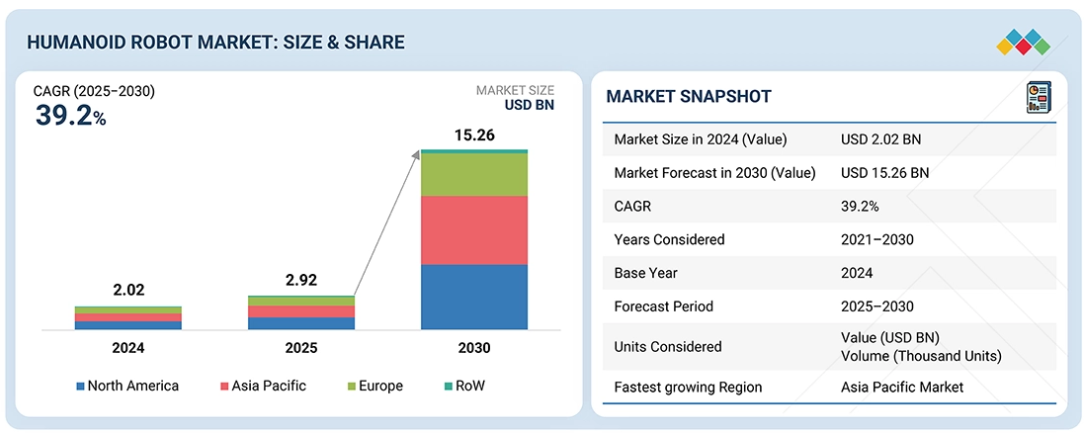
| 世界のヒューマノイドロボット市場は、2025年の29億2,000万米ドルから2030年までに152億6,000万米ドルへと成長し、年平均成長率(CAGR)は39.2%に達すると予測されています。この成長は、パーソナルアシスタント、介護、医療分野におけるヒューマノイドロボットの導入拡大に加え、製造、小売、物流分野での労働力増強を目的とした導入増加によって牽引されています。さらに、人工知能、自然言語処理、人間とロボットの相互作用における急速な進歩に加え、アジア太平洋、北米、欧州における大規模な研究開発投資、パイロット導入、および産業横断的なロボット導入を加速させることを目的とした強力な政府主導の取り組みが、市場を後押ししています。 市場規模と予測 • 2025年の市場規模:29億2,000万米ドル • 2030年の予測市場規模:152億6,000万米ドル • 年平均成長率(CAGR)(2025-2030年):39.2% • 二足歩行ロボットセグメント:最も高いCAGR • アジア太平洋地域:最も急速に成長する市場 主なポイント ヒューマノイドロボット市場は、二足歩行ロボットと車輪駆動ロボットに区分されます。二足歩行ロボットセグメントは、人間の歩行を再現し、複雑な環境を移動できる能力に支えられ、最も高いCAGRで成長すると予想されます。この成長は、高度な移動性と適応性が不可欠な医療、パーソナルアシスタント、産業分野での応用によって支えられています。二足歩行ロボットは、優れた器用さ、人間のようなインタラクション、および運用上の柔軟性を提供するため、人間向けに設計された環境での作業に最適です。リハビリテーション、高齢者介護、および労働力増強における役割の拡大は、世界市場全体での導入をさらに加速させています。一方、車輪駆動型ヒューマノイドロボットは、移動の容易さ、コスト効率、安定性が重要な利点となる小売支援、カスタマーサービス、屋内物流などの用途において、着実な導入が進んでいます。 ヒューマノイドロボット市場は、ハードウェア、ソフトウェア、サービスの3つのセグメントに分類される。ソフトウェアセグメントは、人間とロボットの相互作用や自律的な意思決定を可能にする人工知能(AI)、自然言語処理、コンピュータビジョンの進歩に牽引され、最も高い年平均成長率(CAGR)で成長すると予想される。この成長は、クラウドベースの分析、リアルタイム監視、AIを活用したパーソナライゼーションへの需要増加によってさらに後押しされており、ソフトウェアは医療、パーソナルアシスタント、小売、産業用途におけるヒューマノイドロボットにとって不可欠な基盤となっています。センサー、アクチュエータ、制御システムの必要性から、ハードウェアは依然として市場シェア全体において支配的な地位を占めていますが、サービス分野は統合、メンテナンス、トレーニング支援を通じて着実な成長を遂げています。 ヒューマノイドロボット市場は、教育・娯楽、研究・宇宙探査、パーソナルアシスタンス・介護、捜索救助、広報、製造、その他の用途に区分される。パーソナルアシスタンス・介護セグメントは、高齢者介護、リハビリテーション支援、障がい者支援への需要の高まりに牽引され、最も高い年平均成長率(CAGR)で成長すると予想される。この成長は、ヒューマノイドロボットが伴侶としての役割を果たし、健康状態をモニタリングし、日常的な支援業務を遂行できる能力によってさらに後押しされており、医療や在宅ケアの環境において極めて高い価値を提供しています。教育、研究、製造などのその他の用途でも引き続き堅調な導入が進んでおり、広報や捜索救助の分野でも、導入機会の拡大に伴い注目を集めています。 ヒューマノイドロボット市場は、地域別にアジア太平洋、北米、欧州、その他の地域に分類されます。アジア太平洋地域は、中国、日本、韓国における政府主導の強力な自動化プログラムや、製造業およびサービス業での急速な導入に牽引され、最も高い年平均成長率(CAGR)で成長すると予想される。北米は、医療や物流分野における広範な研究開発(R&D)や実証導入により強い勢いを見せており、一方、欧州は協働ロボットに関する取り組みや規制の枠組みに支えられ、イノベーションの主要な拠点であり続けている。その他の地域では、新興用途における導入が徐々に進んでいる。 ソフトバンク・ロボティクス・グループ、ROBOTIS Co. Ltd.、Agility Robotics、UBTECH Robotics Corp. Ltd.、PAL Roboticsなどの主要企業は、AIを活用した人間とロボットの相互作用、移動性、自律航行の進歩を通じて市場での存在感を高めている。これらの取り組みは、医療、パーソナルアシスタンス、製造、小売、教育、公共関与などの用途におけるヒューマノイドロボットの商用化を加速し、導入を可能にすることを目的としている。 ヒューマノイドロボット産業は、パーソナルアシスタンス、医療、産業オートメーションにおけるニーズの進化に影響を受けています。AIを活用した人間とロボットの相互作用、高度な移動能力と器用さ、IoTやクラウドプラットフォームとの統合といったトレンドは、機能性とユーザー体験を直接的に向上させます。これらの進歩は、信頼性の高い支援、生産性の向上、顧客エンゲージメントの強化に対するエンドユーザーの需要を牽引し、導入戦略を形作り、ヒューマノイドロボット開発者やソリューションプロバイダーの成長を加速させています。 顧客の顧客に影響を与えるトレンドと変革 ヒューマノイドロボット市場における顧客のビジネスへの影響は、多岐にわたるセクターにおける高度な自動化、パーソナライズされた支援、人間のようなインタラクションへの需要によって牽引されています。医療、パーソナルアシスタンス、製造、小売、物流、教育の各分野でヒューマノイドロボットの導入が活発化しており、介護やサービス業務が主要な焦点領域として浮上しています。人工知能、モビリティ、自然言語処理の進歩は、効率性、適応性、顧客エンゲージメントに対する期待を再定義しています。これらの変化は、ヒューマノイドロボットの導入と商用化への需要を加速させ、この技術を労働力増強と次世代サービス提供における変革の原動力として位置づけています。 市場エコシステム ヒューマノイドロボット市場で活動する主要企業には、ソフトバンク・ロボティクス・グループ、ROBOTIS Co. Ltd.、Agility Robotics、UBTECH Robotics Corp. Ltd.、PAL Robotics、Boston Dynamics、Hanson Roboticsなどのメーカーが含まれます。このエコシステムは、MIT、カーネギーメロン大学、IITなどの研究機関、インテル、ボッシュ、NVIDIAなどの部品サプライヤー、そしてOpenAI、Google AI、DeepMindなどのAI開発企業にまで広がっています。Willow GarageやAldebaran Roboticsといったソフトウェア開発企業は、インタラクション機能の向上に貢献しており、一方、ディズニー、Robotel、ユニバーサル、日本航空などのエンドユーザーは、ヒューマノイドロボットの導入を積極的に進めています。PAL RoboticsやROBOTISなどのインテグレーター、およびRoboTiQやRoboKindなどのサービス・サポートプロバイダーは、導入拡大において重要な役割を果たしています。Amazon Roboticsなどのサプライヤーやディストリビューターも、このエコシステムをさらに支えています。 市場セグメント ヒューマノイドロボット市場(タイプ別) ヒューマノイドロボット市場(提供形態別) ヒューマノイドロボット市場(用途別) 地域 予測期間中、アジア太平洋地域が世界のヒューマノイドロボット市場で最も急速に成長する地域となる見込み アジア太平洋地域は、人工知能、機械学習、ロボット工学の研究における急速な進歩に加え、医療、教育、および産業オートメーション分野での導入拡大に牽引され、ヒューマノイドロボット市場において最も急速に成長する地域になると予測されています。同地域には主要なイノベーターが拠点を置き、部品、AI開発、先端製造のための広範なエコシステムが整備されているため、生産と商業化の中心的なハブとなっています。自動化、スマート製造、AI統合を推進する政府主導の強力な取り組みに加え、主要セクターにおけるインダストリー4.0の導入が、市場の成長をさらに加速させている。中国、日本、韓国などの国々がヒューマノイドロボットのイノベーションの最前線に立っており、アジア太平洋地域が世界ヒューマノイドロボット市場の主要な成長エンジンとしての地位を強めている。 ヒューマノイドロボット市場:企業評価マトリックス ヒューマノイドロボット市場の評価マトリックスにおいて、ソフトバンク・ロボティクス・グループ(Star)は、小売、教育、ホスピタリティ、医療分野で広く導入されている「Pepper」や「NAO」といったヒューマノイドロボットの包括的なポートフォリオと、強力なグローバルな存在感により首位に立っている。高度なAI駆動型インタラクション、多言語コミュニケーション、スケーラブルな導入モデルを統合する能力により、ソフトバンク・ロボティクスは市場における支配的なプレーヤーとしての地位を確立している。ボストン・ダイナミクス(新興リーダー)は、高度なモビリティおよびロボット工学における専門知識を活かし、動的な移動技術や産業用途におけるイノベーションを通じて、ヒューマノイド分野での存在感を拡大しています。ソフトバンク・ロボティクスが実績ある大規模導入と戦略的提携によって市場リーダーシップを牽引する一方、ボストン・ダイナミクスは強力な成長の勢いを見せ、進化を続けるヒューマノイドロボット市場において、リーダーのクアドラントに近づく態勢を整えています。 |
The global humanoid robot market is projected to grow from USD 2.92 billion in 2025 to USD 15.26 billion by 2030, registering a CAGR of 39.2%. Growth is being propelled by rising adoption of humanoid robots in personal assistance, caregiving, and healthcare applications, alongside increasing deployment in manufacturing, retail, and logistics for workforce augmentation. The market is further supported by rapid advancements in artificial intelligence, natural language processing, and human–robot interaction, coupled with large-scale R&D investments, pilot deployments, and strong government initiatives in Asia Pacific, North America, and Europe aimed at accelerating robotics adoption across industries.
Market Size & Forecast
• 2025 Market Size: USD 2.92 Billion
• 2030 Projected Market Size: USD 15.26 Billion
• CAGR (2025-2030): 39.2%
• Biped robot segment: Highest CAGR
• Asia Pacific : Fastest growing market
KEY TAKEAWAYS
• The humanoid robot market is segmented into biped and wheel drive robots. The biped robot segment is expected to grow at the highest CAGR, driven by their ability to replicate human locomotion and navigate complex environments. This growth is supported by their applications in healthcare, personal assistance, and industrial settings, where advanced mobility and adaptability are critical. Biped robots offer superior dexterity, human-like interaction, and operational flexibility, making them well-suited for tasks in environments designed for humans. Their expanding role in rehabilitation, elderly care, and workforce augmentation is further accelerating adoption across global markets. Wheel drive humanoid robots, on the other hand, are witnessing steady adoption in applications such as retail assistance, customer service, and indoor logistics, where ease of navigation, cost efficiency, and stability are critical advantages.
• The humanoid robot market is segmented into hardware, software, and services. The software segment is expected to grow at the highest CAGR, driven by advancements in artificial intelligence, natural language processing, and computer vision that enable enhanced human–robot interaction and autonomous decision-making. This growth is further supported by increasing demand for cloud-based analytics, real-time monitoring, and AI-driven personalization, making software a critical enabler for humanoid robots across healthcare, personal assistance, retail, and industrial applications. Hardware continues to dominate in terms of overall market share due to the need for sensors, actuators, and control systems, while services are witnessing steady growth through integration, maintenance, and training support.
• The humanoid robot market is segmented into education and entertainment, research & space exploration, personal assistance and care giving, search and rescue, public relations, manufacturing, and other applications. The personal assistance and care giving segment is expected to grow at the highest CAGR, driven by the rising demand for elderly care, rehabilitation support, and assistance for individuals with disabilities. This growth is further supported by humanoid robots’ ability to provide companionship, monitor health conditions, and perform daily assistance tasks, making them highly valuable in healthcare and homecare environments. Other applications such as education, research, and manufacturing continue to see strong adoption, while public relations and search and rescue are gaining traction with expanding deployment opportunities.
• The humanoid robot market is segmented by region into Asia Pacific, North America, Europe, and Rest of the World. Asia Pacific is expected to grow at the highest CAGR, driven by strong government-backed automation programs and rapid adoption in manufacturing and services across China, Japan, and South Korea. North America shows strong momentum with extensive R&D and pilot deployments in healthcare and logistics, while Europe remains a key hub for innovation supported by collaborative robotics initiatives and regulatory frameworks. The Rest of the World is witnessing gradual adoption in emerging applications.
• Major players including SoftBank Robotics Group, ROBOTIS Co. Ltd., Agility Robotics, UBTECH Robotics Corp. Ltd., and PAL Robotics are strengthening their market presence through advancements in AI-driven human–robot interaction, mobility, and autonomous navigation. These initiatives are aimed at accelerating commercialization and enabling adoption of humanoid robots across healthcare, personal assistance, manufacturing, retail, education, and public engagement applications.
The humanoid robot industry is influenced by evolving needs in personal assistance, healthcare, and industrial automation. Trends such as AI-driven human–robot interaction, advanced mobility and dexterity, and integration with IoT and cloud platforms directly enhance functionality and user experience. These advancements drive end-user demand for reliable assistance, improved productivity, and enhanced customer engagement, shaping deployment strategies and accelerating the growth of humanoid robot developers and solution providers.
TRENDS & DISRUPTIONS IMPACTING CUSTOMERS’ CUSTOMERS
The impact on customers’ business in the humanoid robot market is driven by the demand for advanced automation, personalized assistance, and human-like interaction across multiple sectors. Healthcare, personal assistance, manufacturing, retail, logistics, and education are actively adopting humanoid robots, with caregiving and service roles emerging as key focus areas. Advancements in artificial intelligence, mobility, and natural language processing are reshaping expectations around efficiency, adaptability, and customer engagement. These shifts are accelerating demand for humanoid robot deployment and commercialization, positioning the technology as a transformative force in workforce augmentation and next-generation service delivery.
MARKET ECOSYSTEM
Key players operating in the humanoid robot market include manufacturers such as SoftBank Robotics Group, ROBOTIS Co. Ltd., Agility Robotics, UBTECH Robotics Corp. Ltd., PAL Robotics, Boston Dynamics, and Hanson Robotics. The ecosystem extends across research institutes including MIT, Carnegie Mellon University, and IIT; component providers such as Intel, Bosch, and NVIDIA; and AI developers including OpenAI, Google AI, and DeepMind. Software developers like Willow Garage and Aldebaran Robotics contribute to enhancing interaction capabilities, while end users such as Disney, Robotel, Universal, and Japan Airlines are actively deploying humanoid robots. Integrators including PAL Robotics and ROBOTIS, and service and support providers such as RoboTiQ and RoboKind, play a critical role in scaling adoption. Suppliers and distributors including Amazon Robotics further support the ecosystem.
MARKET SEGMENTS
Humanoid Robot Market, By Type
Humanoid Robot Market, By Offering
Humanoid Robot Market, By Application
REGION
Asia Pacific to be fastest-growing region in global Humanoid Robot Market during forecast period
Asia Pacific is projected to be the fastest-growing market for humanoid robots, driven by rapid advancements in artificial intelligence, machine learning, and robotics research, along with expanding adoption across healthcare, education, and industrial automation. The region is home to leading innovators and an extensive ecosystem for components, AI development, and advanced manufacturing, making it a central hub for production and commercialization. Strong government-backed initiatives promoting automation, smart manufacturing, and AI integration, coupled with Industry 4.0 adoption across key sectors, are further accelerating market growth. Countries such as China, Japan, and South Korea are at the forefront of humanoid robot innovation, reinforcing Asia Pacific’s position as the dominant growth engine of the global humanoid robot market.
Humanoid Robot Market: COMPANY EVALUATION MATRIX
In the humanoid robot market matrix, SoftBank Robotics Group (Star) leads with a strong global presence and a comprehensive portfolio of humanoid robots such as Pepper and NAO, widely deployed in retail, education, hospitality, and healthcare. Its ability to integrate advanced AI-driven interaction, multilingual communication, and scalable deployment models has positioned SoftBank Robotics as the dominant player in the market. Boston Dynamics (Emerging Leader), leveraging its expertise in advanced mobility and robotics engineering, is expanding its footprint in the humanoid segment through innovations in dynamic locomotion and industrial applications. While SoftBank Robotics drives market leadership with proven large-scale deployments and strategic alliances, Boston Dynamics demonstrates strong growth momentum, positioning itself to move closer to the leaders’ quadrant within the evolving humanoid robot market.
1. 序論
2. 調査手法
3. エグゼクティブサマリー
4. プレミアムインサイト
5. 市場概要
ヒューマノイドロボットは、高コストや安全性への懸念がある一方で、小売、医療、教育分野に変革をもたらしている。
5.1 序論
5.2 市場ダイナミクス
5.2.1 推進要因
5.2.1.1 人工知能および機械学習の進展
5.2.1.2 高度機能を備えたヒューマノイドロボット開発への継続的な注力
5.2.1.3 教育分野におけるヒューマノイドの利用拡大
5.2.1.4 小売店舗におけるヒューマノイドロボット配備の急増
5.2.1.5 医療分野からのヒューマノイドロボット需要の拡大
5.2.2 抑制要因
5.2.2.1 ヒューマノイドロボットに必要な巨額の設備投資と広範な研究開発費
5.2.2.2 未検証環境におけるヒューマノイドロボットの性能上の制約
5.2.3 機会
5.2.3.1 世界的な高齢者人口の急増
5.2.3.2 物流分野からのヒューマノイドロボット需要の増加
5.2.3.3 捜索救助活動におけるヒューマノイドロボット採用の拡大
5.2.4 課題
5.2.4.1 ヒューマノイドロボット導入を制約する安全性への懸念
5.2.4.2 ヒューマノイドロボットの利点に関する認知不足
5.3 バリューチェーン分析
5.4 価格分析
5.4.1 主要企業の平均販売価格動向(タイプ別)
5.4.2 ヒューマノイドロボットの平均販売価格動向(地域別)
5.5 エコシステム分析
5.6 ポーターのファイブフォース分析
5.6.1 新規参入の脅威
5.6.2 供給者の交渉力
5.6.3 買い手の交渉力
5.6.4 代替品の脅威
5.6.5 競争の激しさ
5.7 主要ステークホルダーと購買基準
5.7.1 購買プロセスにおける主要ステークホルダー
5.7.2 購買基準
5.8 ケーススタディ分析
5.8.1 Eobuwie.plの小売店がPepperヒューマノイドロボット導入により顧客体験を向上
5.8.2 Princess Nourah UniversityがPepperヒューマノイドロボット導入により学生の関与度とイノベーションを向上
5.8.3 Neom Bay AirportがPepperヒューマノイドロボット採用により効率的な旅行体験を創出
5.8.4 AramcoがPepperヒューマノイドロボット活用により従業員エンゲージメントを向上
5.8.5 Dubai Electricity and Water AuthorityがPepperヒューマノイドロボット導入により顧客エンゲージメントを向上
5.9 貿易分析
5.9.1 輸入動向(HSコード 850860)
5.9.2 輸出動向(HSコード 850860)
5.10 関税および規制環境
5.10.1 関税分析(HSコード850860適合製品)
5.10.2 規制当局、政府機関、その他の組織
5.10.3 規制基準
5.11 特許分析
5.12 主要会議・イベント(2025~2026年)
5.13 顧客事業に影響を与えるトレンド/ディスラプション
5.14 投資・資金調達の状況
5.15 技術分析
5.15.1 中核技術
5.15.1.1 人工知能および機械学習
5.15.1.2 センサーとアクチュエーター
5.15.1.3 自然言語処理
5.15.2 補完技術
5.15.2.1 クラウドコンピューティング
5.15.2.2 エッジコンピューティング
5.15.3 隣接技術
5.15.3.1 5G技術と産業自動化
5.15.3.2 モノのインターネット(IoT)
5.16 AI/生成AIがヒューマノイドロボット市場に与える影響
5.16.1 ヒューマノイドロボット市場における主要なAIユースケース
5.16.2 用途別に見たヒューマノイドロボットメーカーによるAI統合
5.16.3 隣接エコシステムとの相互接続
5.16.3.1 サービスロボティクス市場への影響
5.17 2025年米国関税がヒューマノイドロボット市場に与える影響
5.17.1 トランプ関税がヒューマノイドロボット市場にもたらす課題
5.17.2 トランプ関税下でのヒューマノイドロボット市場の機会
5.17.3 戦略的提携と政府支援
6. ヒューマノイドロボット市場:タイプ別
2030年までの市場規模・成長率予測分析(百万米ドル)|データ表38点
6.1 序論
6.2 二足歩行型
6.2.1 複雑な作業をより高精度で実行できる能力が需要を押し上げる
6.3 車輪駆動型
6.3.1 テーマパーク/遊園地や科学イベントでの利用拡大がセグメント成長を後押し
7. ヒューマノイドロボット市場:提供内容別
2030年までの市場規模・成長率予測分析(百万米ドル)|データ表20点
7.1 序論
7.2 ハードウェア
7.2.1 センサー
7.2.1.1 より高い精度、適応性、安全性で作業するロボット構築ニーズがセンサー採用を促進
7.2.1.2 ジャイロスコープ
7.2.1.3 マイクロフォン
7.2.1.4 加速度計
7.2.1.5 傾斜センサー
7.2.1.6 力/トルクセンサー
7.2.1.7 位置センサー
7.2.1.8 ビジョン/画像センサー
7.2.1.9 その他のセンサー
7.2.2 アクチュエーター
7.2.2.1 エネルギーを運動に変換する能力が採用を促進
7.2.2.2 電気式
7.2.2.3 空気圧式
7.2.2.4 油圧式
7.2.2.5 圧電式
7.2.2.6 超音波式
7.2.3 電源
7.2.3.1 ロボット用途向け高性能電池の登場がセグメント成長を後押し
7.2.4 制御システム/コントローラー
7.2.4.1 学習・適応・複雑作業を効率的に実行できるロボット需要の急増がセグメント成長を促進
7.2.5 その他のハードウェア部品
7.3 ソフトウェア
7.3.1 高度機能やカスタマイズ機能を備えたロボットの複雑作業での利用拡大がセグメント成長を後押し
7.3.2 マニピュレーション
7.3.3 ナビゲーション
7.3.4 インタラクション
7.4 サービス
7.4.1 ロボットの性能最大化と寿命延長に向けたメーカーの注力拡大がサービス需要を牽引
8. ヒューマノイドロボット市場:用途別
2030年までの市場規模・成長率予測分析(百万米ドル)|データ表36点
8.1 序論
8.2 教育・エンターテインメント
8.2.1 語学チューターや伴侶としてのロボット利用拡大がセグメント成長を後押し
8.3 研究・宇宙探査
8.3.1 極端な温度や高放射線環境に耐えられる能力が宇宙用途での採用を促進
8.4 パーソナルアシスタンス・介護
8.4.1 高齢者や障がい者による介護サービス需要の高まりがセグメント成長を支える
8.5 捜索・救助
8.5.1 危険環境で人命救助作業を行える能力が捜索救助用途での採用を拡大
8.6 パブリックリレーション
8.6.1 小売
8.6.1.1 販売促進活動におけるロボット採用拡大がセグメント成長に寄与
8.6.2 ホスピタリティ
8.6.2.1 顧客満足度向上に向けたホスピタリティ施設の注力拡大がロボット需要を牽引
8.7 製造
8.7.1 製造効率向上への注力拡大がヒューマノイドロボット需要を刺激
8.8 その他の用途
9. ヒューマノイドロボット市場:地域別
10地域を包括し、14か国を国別に詳細分析|データ表66点
9.1 序論
9.2 北米
9.2.1 北米のマクロ経済見通し
9.2.2 米国
9.2.2.1 研究、宇宙探査、介護、娯楽用途におけるヒューマノイドロボット需要の大きさが市場を牽引
9.2.3 カナダ
9.2.3.1 病院や銀行におけるヒューマノイドロボット利用拡大が市場成長を支える
9.2.4 メキシコ
9.2.4.1 個人向け・公共向け用途におけるサービスロボット採用拡大が市場成長に寄与
9.3 欧州
9.3.1 欧州のマクロ経済見通し
9.3.2 英国
9.3.2.1 ヒューマノイドロボティクス分野での大規模研究開発が市場成長を加速
9.3.3 ドイツ
9.3.3.1 ロボティクスに対する政府投資が市場を牽引
9.3.4 フランス
9.3.4.1 サービスロボットを生産する多数の中小企業の存在が機会を創出
9.3.5 イタリア
9.3.5.1 医療分野におけるヒューマノイド導入拡大が市場成長を後押し
9.3.6 スペイン
9.3.6.1 教育機関およびサービス産業におけるヒューマノイド配備拡大が市場を押し上げる
9.3.7 その他の欧州
9.4 アジア太平洋
9.4.1 アジア太平洋のマクロ経済見通し
9.4.2 中国
9.4.2.1 ヒューマノイドロボットの量産化への注力拡大が市場成長を後押し
9.4.3 日本
9.4.3.1 高齢化と少子化による労働力減少が需要を押し上げる
9.4.4 インド
9.4.4.1 AIおよびロボティクスに関する政府主導の研究開発活動が有望な機会を創出
9.4.5 韓国
9.4.5.1 スマートファクトリー開発の進展が市場成長を支える
9.4.6 オーストラリア
9.4.6.1 医療、教育、顧客サービス分野での自動化利用の急増が需要を押し上げる
9.4.7 シンガポール
9.4.7.1 ロボティクスの研究開発を促進する政府政策の展開が市場成長を後押し
9.4.8 その他のアジア太平洋
9.5 その他地域
9.5.1 その他地域のマクロ経済見通し
9.5.2 南米
9.5.2.1 複数産業における自動化利用拡大が需要を押し上げる
9.5.3 中東・アフリカ
9.5.3.1 救助・防衛用途でのロボット採用拡大が市場を牽引
9.5.3.2 GCC諸国
9.5.3.3 中東・アフリカのその他地域
10. 競争環境
市場支配力や競争環境を形づくる戦略的動向に関する洞察を提供。
10.1 序論
10.2 主要企業が採用した戦略(2021~2024年)
10.3 主要企業の売上分析(2021~2023年)
10.4 主要企業の市場シェア分析(2024年)
10.5 企業評価額および財務指標
10.6 ブランド/製品比較
10.7 企業評価マトリクス:主要企業(2024年)
10.7.1 スター企業
10.7.2 新興リーダー
10.7.3 広範展開プレーヤー
10.7.4 参加企業
10.7.5 企業フットプリント:主要企業(2024年)
10.7.5.1 企業フットプリント
10.7.5.2 タイプ別フットプリント
10.7.5.3 提供内容別フットプリント
10.7.5.4 用途別フットプリント
10.7.5.5 地域別フットプリント
10.8 企業評価マトリクス:スタートアップ/中小企業(2024年)
10.8.1 進展企業
10.8.2 対応力の高い企業
10.8.3 ダイナミック企業
10.8.4 スターティングブロックス
10.8.5 競争ベンチマーキング:スタートアップ/中小企業(2024年)
10.8.5.1 主要スタートアップ/中小企業の詳細一覧
10.8.5.2 主要スタートアップ/中小企業の競争ベンチマーキング
10.9 競争シナリオ
10.9.1 製品投入
10.9.2 取引
10.9.3 事業拡大
11. 企業プロファイル
主要市場プレーヤーの詳細な企業プロファイル。事業概要、製品・サービスのポートフォリオ、最近の動向、独自のアナリスト視点(MnM View)を収録。
11.1 主要企業
11.1.1 SoftBank Robotics Group
11.1.1.1 事業概要
11.1.1.2 提供製品/ソリューション/サービス
11.1.1.3 最近の動向
11.1.1.4 MnM View
11.1.2 Robotis
11.1.3 UBTECH Robotics Corp Ltd.
11.1.4 PAL Robotics
11.1.5 Agility Robotics
11.1.6 Kawada Robotics Corporation
11.1.7 Toyota Motor Corporation
11.1.8 Honda Motor Co., Ltd.
11.1.9 Hanson Robotics Ltd.
11.1.10 Samsung
11.1.11 Tesla
11.2 その他の企業
11.2.1 Engineered Arts Limited
11.2.2 National Aeronautics and Space Administration
11.2.3 Robo Garage Co., Ltd.
11.2.4 Istituto Italiano di Tecnologia
11.2.5 Robotics Lab
11.2.6 Hajime Research Institute, Ltd.
11.2.7 Promobot Corp.
11.2.8 EZ-Robot
11.2.9 Macco Robotics
11.2.10 Boston Dynamics
11.2.11 Advanced Telecommunications Research Institute International
11.2.12 WowWee Group Limited
11.2.13 Apptronik
11.2.14 Sanbot Innovation Technology., Ltd
11.2.15 Figure
11.2.16 Karlsruhe Institute of Technology
11.2.17 Beyond Imagination
11.2.18 1X Technologies
11.2.19 LimX Dynamics Inc.
12. 付録
12.1 ディスカッションガイド
12.2 KnowledgeStore:MarketsandMarketsのサブスクリプションポータル
12.3 カスタマイズオプション
12.4 関連レポート
12.5 著者情報
 サービスロボットの世界市場(~2029年) The service robot market is projected to reach USD 98.65 billion by 2029 from USD 47.10 billion in 2024, at a CAGR of 15.9% from 2024 to 2029. The rising adoption of robots in various verticals in order to gain higher return on investments is driving market growth. KEY TAKEAWAYS • The North America …
 ストレッチフィルムの世界市場2025-2031 世界のストレッチフィルム市場は、2024年時点での市場規模が未公表であり、2025年から2031年の予測期間中に年平均成長率(CAGR)%で成長し、2031年には再調整された市場規模に達すると予測されています。ストレッチフィルムとは、パレット上の商品をまとめるために使用される高伸縮性の包装フィルムであり、リニア低密度ポリエチレン(LLDPE)や低密度ポリエチレン(LDPE)製が主流で、ポリプロピレン(PP)やポリ塩化ビニル(PVC)製と比べても広く用いられています。これらのフィルムは、荷物の固定力が高く、包装工程の効率化、コスト削減、優れた荷物保護性能などの利点があります。 地域別では、202…
 ホットメルト接着剤の世界市場2026-2032 The global Hot Melt Adhesives market size is predicted to grow from US$ 8554 million in 2025 to US$ million in 2032; it is expected to grow at a CAGR of % from 2026 to 2032. The hot melt adhesives are defined as adhesives that melt and flow on application of heat and solidify on cooling to give a st…
- ガラス製調理器具の世界市場2024:メーカー別、地域別、タイプ・用途別 GlobalInfoResearch社の最新調査によると、世界のガラス製調理器具市場規模は2023年にxxxx米ドルと評価され、2030年までに年平均xxxx%でxxxx米ドルに成長すると予測されています。 本レポートは、世界のガラス製調理器具市場に関する詳細かつ包括的な分析です。メーカー別、地域別・国別、タイプ別、用途別の定量分析および定性分析を行っています。市場は絶え間なく変化しているため、本レポートでは競争、需給動向、多くの市場における需要の変化に影響を与える主な要因を調査しています。選定した競合企業の会社概要と製品例、および選定したいくつかのリーダー企業の2024年までの市場シェア予測…
- ブースターボールの世界市場2024:メーカー別、地域別、タイプ・用途別 GlobalInfoResearch社の最新調査によると、世界のブースターボール市場規模は2023年にxxxx米ドルと評価され、2030年までに年平均xxxx%でxxxx米ドルに成長すると予測されています。 本レポートは、世界のブースターボール市場に関する詳細かつ包括的な分析です。メーカー別、地域別・国別、タイプ別、用途別の定量分析および定性分析を行っています。市場は絶え間なく変化しているため、本レポートでは競争、需給動向、多くの市場における需要の変化に影響を与える主な要因を調査しています。選定した競合企業の会社概要と製品例、および選定したいくつかのリーダー企業の2024年までの市場シェア予測…