 | • レポートコード:MR7933NE4009 • 出版社/出版日:MarketsandMarkets / 2025年10月 • レポート形態:英語、PDF、320ページ • 納品方法:Eメール(納期:1日) • 産業分類:バイオ |
| Single User(1名様閲覧用) | ¥772,200 (USD4,950) | ▷ お問い合わせ |
| Multi User(5名様閲覧用) | ¥1,037,400 (USD6,650) | ▷ お問い合わせ |
| Corporate User(閲覧人数無制限) | ¥1,271,400 (USD8,150) | ▷ お問い合わせ |
• お支払方法:銀行振込(納品後、ご請求書送付)
レポート概要
| 世界の3D細胞培養市場は、2024年の11億8000万米ドルから、2030年までに22億6000万米ドルに達すると予測されており、予測期間中の年平均成長率(CAGR)は11.7%となる見込みです。3D細胞培養の導入拡大や、3D細胞培養研究への資金提供の増加といった要因が、市場の成長を牽引しています。 製品市場では、足場(スキャフォールド)を用いた3D細胞培養セグメントが最大の市場シェアを占めた。 製品別に見ると、3D細胞培養市場は、足場を用いた3D細胞培養、足場を用いない3D細胞培養、マイクロ流体技術を用いた3D細胞培養、および磁気・バイオプリンティングを用いた3D細胞培養に分類される。2024年には、足場を用いた3D細胞培養セグメントが最大のシェアを占めた。ハイドロゲル/ECMアナログが、このセグメントの成長における主要な要因として浮上している。ハイドロゲルへの需要の高まりにより、主要な市場プレーヤーは新製品の開発および市場投入に注力している。また、生体適合性があり無毒であるため、研究や創薬への利用に理想的である。 2024年には、がんおよび幹細胞研究セグメントがアプリケーション市場で最大のシェアを占めた。 用途別では、市場はがん・幹細胞研究、創薬・毒性試験、組織工学・再生医療に分類される。2024年には、がん・幹細胞研究セグメントが最大の市場シェアを占めた。がんの有病率の増加、および政府や民間セクターによるがん研究への多額の資金投入が、この用途セグメントの成長を牽引する主な要因となっている。 アジア太平洋地域は、最も急速に成長する地域市場となる見込みである。 3D細胞培養市場は、欧州、アジア太平洋、北米、ラテンアメリカ、中東・アフリカに区分される。予測期間中、アジア太平洋市場が最も急速に成長する地域セグメントになると予想される。この市場の成長は、有利な規制ガイドラインの存在、細胞培養に基づくワクチン生産に対する政府の支援、低い製造コスト、そして新興アジア諸国へのグローバル市場プレーヤーの注目の高まりに起因している。抗体やタンパク質系医薬品などのバイオ医薬品市場も、アジア太平洋地域で拡大している。バイオテクノロジーに基づく医薬品は、これらに対する研究および政府資金の増加により、研究業界の主要な推進要因の一つになると予想される。世界の製薬企業は、活況を呈するアジア市場を開拓し、製造を同地域に移管することで生産コストを削減するため、ますますアジアへ進出している。 本レポートのために実施された一次インタビューは、次のように分類できる: 回答者別:ティア1 - 25%、ティア2 - 35%、ティア3 - 40% 役職別:Cレベル幹部-55%、取締役-20%、その他-25% 地域別:北米-45%、欧州-20%、アジア太平洋-20%、ラテンアメリカ-10%、中東-3%、アフリカ-2% 世界の3D細胞培養市場における主要企業は、サーモフィッシャーサイエンティフィック社(米国)、メルクKGaA(ドイツ)、コーニング社(米国)、ロンザ(スイス)、テカン・トレーディングAG(スイス)、アバンター、レプロセル株式会社(日本)、3DバイオテックLLC. (米国)、S-BIO、Vaupell Holdings Inc.(米国)、Advanced BioMatrix Inc.(米国)、UPM Biomedicals(フィンランド)、SYNTHECON, INCORPORATED(米国)、Emulate, Inc.(米国)、CN Bio Innovations Ltd.(英国)、Kirkstall Ltd.(英国)、 Lena Biosciences(米国)、TissUse GmbH(ドイツ)、Cellendes GmbH(ドイツ)、Greiner Bio-one International GmbH(ドイツ)、AMSBIO(英国)、MIMETAS B.V.(オランダ)、およびPromocell GmbH(ドイツ)。 調査範囲 本調査レポートでは、3D細胞培養市場を、製品別(足場を用いた3D細胞培養、足場を用いない3D細胞培養、マイクロ流体技術を用いた3D細胞培養、および磁気・バイオプリンティングを用いた3D細胞培養)、用途別(がん・幹細胞研究、創薬・毒性試験、組織工学・再生医療)、 エンドユーザー(製薬・バイオテクノロジー企業、研究機関、化粧品業界、その他のエンドユーザー)、および地域(北米、欧州、アジア太平洋、ラテンアメリカ、中東、アフリカ)ごとに分類しています。本レポートの範囲には、3D細胞培養市場の成長に影響を与える推進要因、課題、機会、制約などの主要な要因に関する詳細情報が含まれています。主要な業界プレーヤーについて詳細な分析を行い、その事業概要、サービスポートフォリオ、提携、パートナーシップ、事業拡大、契約、買収などの主要戦略、および3D細胞培養市場に関連する最近の動向に関する洞察を提供しています。本レポートでは、3D細胞培養市場のエコシステムにおける主要プレーヤーや新興スタートアップの競合分析を網羅しています。 本レポートの範囲には、3D細胞培養市場の成長に影響を与える主要な要因(推進要因、制約要因、課題、機会など)に関する詳細情報が含まれています。主要な業界プレイヤーについて徹底的な分析を行い、各社の事業概要、ソリューション、サービス、主要戦略、新製品の発売、買収、および3D細胞培養市場に関連する最近の動向に関する洞察を提供しています。本レポートでは、3D細胞培養市場エコシステムにおける新興スタートアップ企業の競合分析も網羅しています。 本レポートを購入する主なメリット: 本レポートは、3D細胞培養市場全体およびそのサブセグメントの売上高について、最も正確な推計値を提供することで、市場リーダーや新規参入企業を支援します。また、ステークホルダーが競争環境をより深く理解し、自社のビジネスを最適な位置づけに導き、適切な市場参入戦略を策定するための洞察を得るのにも役立ちます。本レポートにより、ステークホルダーは市場の動向を把握し、主要な市場推進要因、制約要因、機会、課題に関する情報を得ることができます。 本レポートでは、以下のポイントに関する洞察を提供しています: 主要な推進要因(動物実験の代替手法開発への高い注目、個別化医療の普及拡大、政府による支援・資金提供の増加、学術界と研究機関との連携強化)の分析、制約要因(3D細胞培養技術の導入コストの高さ、3D細胞培養における広く受け入れられた単一の標準化の欠如)、 機会(マイクロ流体技術に基づく3D細胞培養の台頭)、および課題(3D細胞培養製品における一貫性の欠如、プラスチック廃棄物処理や消耗品への高い依存度)など、3D細胞培養市場の成長に影響を与える要因に関する洞察を提供します。 製品開発/イノベーション:3D細胞培養市場における新発売製品に関する詳細な分析 市場開発:収益性の高い市場に関する包括的な情報――本レポートでは、さまざまな地域にわたる3D細胞培養市場を分析しています。 市場の多角化:3D細胞培養市場における新たなサービス、未開拓の地域、最近の動向、および投資に関する網羅的な情報。 競合評価:サーモフィッシャーサイエンティフィック社(米国)、メルクKGaA(ドイツ)、コーニング社(米国)、ロンザ(スイス)、アバンター社(米国)などの主要企業の市場シェア、成長戦略、サービス提供内容に関する詳細な評価 |
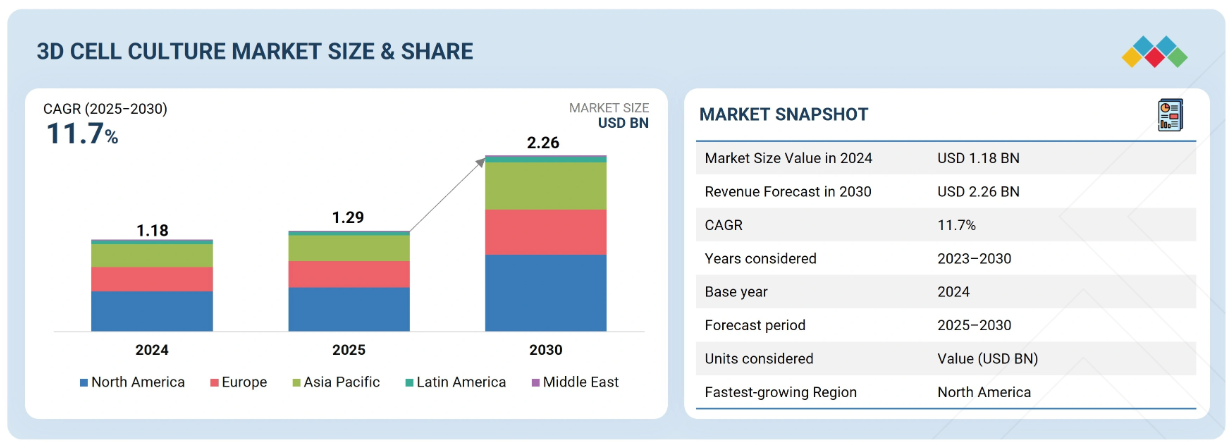
The global 3D cell culture market is projected to reach USD 2.26 billion by 2030 from USD 1.18 billion in 2024, at a CAGR of 11.7% during the forecast period. Factors such as increased adoption of 3D cell culture and a rise in funding for 3D cell culture research drive market growth.
The scaffold-based 3D cell culture segment accounted for the highest market share in the product market.
Based on the product, the 3D cell culture market is segmented into scaffold-based 3D cell cultures, scaffold-free 3D cell cultures, microfluidics-based 3D cell cultures, and magnetic & bioprinted 3D cell cultures. The scaffold-based 3D cell cultures segment accounted for the largest share in 2024. Hydrogels/ECM analogs have emerged as the key contributor to segment growth. Increased demand for hydrogels is raising the focus of key market players on the development and launch of new products in the market. It is also biocompatible and non-toxic, making it ideal for use in research and drug development.
The cancer and stem cell research segment accounted for the largest share of the application market in 2024.
Based on the application, the market is segmented into cancer & stem cell research, drug discovery & toxicology testing, and tissue engineering & regenerative medicine. Cancer & stem cell segment research accounted for the largest market share in 2024. The increasing prevalence of cancer and significant funding initiatives for cancer research from the government and the private sector are major factors driving the growth of this application segment.
The Asia Pacific region is likely to be the fastest-growing regional market.
The 3D cell culture market is segmented into Europe, Asia Pacific, North America, Latin America, and the Middle East & Africa. The Asia Pacific market is expected to be the fastest-growing regional segment during the forecast period. Growth in this market is attributed to the presence of favorable regulatory guidelines, government support for cell culture-based vaccine production, low manufacturing costs, and the growing focus of global market players on emerging Asian countries. The markets for biologics such as antibodies and protein-based drugs are also on the rise in the Asia Pacific region. Biotechnology-based drugs are anticipated to be one of the key drivers for the research industry due to increased research and government funds provided for these drugs. Global pharmaceutical firms are increasingly moving to Asia to tap into its thriving market and lower their production costs by shifting manufacturing to the region.
The primary interviews conducted for this report can be categorized as follows:
• By Respondent: Tier 1- 25%, Tier 2- 35%, and Tier 3- 40%
• By Designation: C-level Executives- 55%, Directors- 20%, and Others- 25%
• By Region: North America- 45%, Europe- 20%, the Asia Pacific- 20%, Latin America- 10%, the Middle East- 3%, and Africa- 2%
The top players in the global 3D cell culture market are Thermo Fisher Scientific, Inc. (US), Merck KGaA (Germany), Corning Incorporated (US), Lonza (Switzerland), Tecan Trading AG (Switzerland), Avantor, REPROCELL Inc. (Japan), 3D Biotek LLC. (US), S-BIO, Vaupell Holdings Inc. (US), Advanced BioMatrix Inc. (US), UPM Biomedicals (Finland), SYNTHECON, INCORPORATED (US), Emulate, Inc. (US), CN Bio Innovations Ltd. (UK), Kirkstall Ltd. (UK), Lena Biosciences (US), TissUse GmbH (Germany), Cellendes GmbH (Germany), Greiner Bio-one International GmbH (Germany), AMSBIO (UK), MIMETAS B.V.(Netherlands), and Promocell GmbH (Germany).
Research Coverage
This research report categorizes the 3D cell culture market by product (scaffold-based 3D cell cultures, scaffold-free 3D cell cultures, microfluidics-based 3D cell cultures, and magnetic & bioprinted 3D cell cultures), application (cancer & stem cell research, drug discovery & toxicology testing, and tissue engineering & regenerative medicine), end user (pharmaceutical & biotechnology companies, research institutes, cosmetics industry, and other end users) and by region (North America, Europe, Asia Pacific, Latin America, Middle East, and Africa). The scope of the report covers detailed information regarding the major factors, such as drivers, challenges, opportunities, and restraints influencing the growth of the 3D cell culture market. A detailed analysis of the key industry players has been done to provide insights into their business overview, service portfolio, key strategies such as collaborations, partnerships, expansions, agreements, and acquisitions, and recent developments associated with the 3D cell culture market. This report covers a competitive analysis of top players and upcoming startups in the 3D cell culture market ecosystem.
The report’s scope covers detailed information regarding the primary factors, such as drivers, restraints, challenges, and opportunities, influencing the growth of the 3D cell culture market. A thorough analysis of the key industry players has been conducted to provide insights into their business overview, solutions, and services; key strategies; new product launches, acquisitions, and recent developments associated with the 3D cell culture market. This report covers the competitive analysis of upcoming startups in the 3D cell culture market ecosystem.
Key Benefits of Buying the Report:
The report will help market leaders/new entrants by providing them with the closest approximations of the revenue numbers for the overall 3D cell culture market and its subsegments. It will also help stakeholders better understand the competitive landscape and gain more insights to better position their business and make suitable go-to-market strategies. This report will enable stakeholders to understand the market’s pulse and provide them with information on the key market drivers, restraints, opportunities, and challenges.
The report provides insights into the following pointers:
• Analysis of key drivers (high focus on developing alternatives to animal testing, increasing adoption of personalized medicine, increased government support and funding, rising academia-research collaborations), restraints (high cost of implementing 3D cell culture technologies, lack of widely accepted or single standardization in 3D cell culture), opportunities (emergence of microfluidic based 3D cell culture), and challenges (lack of consistency in 3D cell culture products, high dependency on plastic waste disposals and consumables) influencing the growth of 3D cell culture market.
• Product Development/Innovation: Detailed insights on newly launched products of the 3D cell culture market
• Market Development: Comprehensive information about lucrative markets – the report analyses the 3D cell culture market across varied regions.
• Market Diversification: Exhaustive information about new services, untapped geographies, recent developments, and investments in the 3D cell culture market.
• Competitive Assessment: In-depth assessment of market shares, growth strategies, and service offerings of leading players such as Thermo Fisher Scientific Inc. (US), Merck KGaA (Germany), Corning Incorporated (US), Lonza (Switzerland), and Avantor Inc. (US), among others
www.marketsandmarkets.com/Market-Reports/3d-cell-culture-market-191072847.html
1. INTRODUCTION
2. RESEARCH METHODOLOGY
3. EXECUTIVE SUMMARY
4. PREMIUM INSIGHTS
5. MARKET OVERVIEW
5.1 INTRODUCTION
5.2 MARKET DYNAMICS
5.2.1 Drivers
5.2.1.1 High Focus on Developing Alternatives to Animal Testing
5.2.1.2 Growing Shift Toward Personalized Medicine
5.2.1.3 Integration of Microphysiological Systems and Organ-on-Chip Platforms
5.2.2 Restraints
5.2.2.1 High Costs of Implementing 3D Cell Culture Technologies
5.2.2.2 Absence of Widely Accepted or Unified Standards for Experimental Protocols
5.2.3 Opportunities
5.2.3.1 High Growth Opportunities and Booming Biopharmaceutical Sector in Emerging Economies
5.2.4 Challenges
5.2.4.1 Lack of Consistency in Scaffold-Based 3D Cell Culture Products
5.2.4.2 High Dependence on Plastic Waste Disposals and Consumables
5.3 TECHNOLOGY ANALYSIS
5.3.1 Key Technologies
5.3.1.1 Microfluidics
5.3.1.2 Bioprinting
5.3.1.3 Organ-on-Chip
5.3.2 Complementary Technologies
5.3.2.1 High-Content Imaging and Automated Microscopy
5.3.2.2 High-Throughput Screening Platforms
5.3.3 Adjacent Technologies
5.3.3.1 Magnetic Levitation
5.3.3.2 Microfabrication
5.4 TRADE ANALYSIS
5.4.1 Import Data
5.4.2 Export Data
5.5 REGULATORY LANDSCAPE
5.5.1 Regulatory Framework
5.5.1.1 North America
5.5.1.2 Europe
5.5.1.3 Asia Pacific
5.5.1.4 Latin America
5.5.1.5 Middle East & Africa
5.5.2 Regulatory Bodies, Government Agencies, and Other Organizations
5.6 PORTER’S FIVE FORCES ANALYSIS
5.6.1 Bargaining Power of Suppliers
5.6.2 Bargaining Power of Buyers
5.6.3 Threat of New Entrants
5.6.4 Threat of Substitutes
5.6.5 Intensity of Competitive Rivalry
5.7 IMPACT OF AI/GENERATIVE AI ON 3D CELL CULTURE MARKET
5.7.1 Introduction
5.7.2 Market Potential of AI in 3D Cell Culture Applications
5.7.3 AI Use Cases
5.7.4 Key Companies Implementing AI
5.7.5 Future of Generative AI in 3D Cell Culture Ecosystem
5.8 IMPACT OF 2025 US TARIFF ON 3D CELL CULTURE MARKET
5.8.1 Introduction
5.8.2 Key Tariff Rates
5.8.3 Price Impact Analysis
5.8.4 Impact on Country/Region
5.8.4.1 US
5.8.4.2 Europe
5.8.4.3 Asia Pacific
5.8.5 Impact on End-Use Industries
5.8.5.1 Pharmaceutical and Biotech Companies
5.8.5.2 Hospitals and Diagnostic Laboratories
5.8.5.3 Academic and Research Institutes
5.8.5.4 Contract Research Organizations & Contract Development and Manufacturing Organizations
6. INDUSTRY TRENDS
6.1 PRICING ANALYSIS
6.1.1 Average Selling Price Trend, by Key Player
6.1.2 Average Selling Price Trend, by Region
6.2 PATENT ANALYSIS
6.2.1 Methodology
6.2.2 Number of Patents Filed
6.2.3 List of Key Patents
6.3 KEY CONFERENCES AND EVENTS, 2025–2026
6.4 INVESTMENT AND FUNDING SCENARIO
6.5 VALUE CHAIN ANALYSIS
6.6 ECOSYSTEM ANALYSIS
6.7 KEY STAKEHOLDERS AND BUYING CRITERIA
6.7.1 Key Stakeholders in Buying Process
6.7.2 Key Buying Criteria
6.8 TRENDS/DISRUPTIONS IMPACTING CUSTOMER BUSINESS
7. 3D CELL CULTURE MARKET, BY TYPE
7.1 INTRODUCTION
7.2 SCAFFOLD-BASED 3D CELL CULTURES
7.2.1 Hydrogels/ECM Analogs
7.2.1.1 Hydrogels/ECM Analogs to Dominate Scaffold-Based 3D Cell Culture Market During Forecast Period
7.2.2 Solid Scaffolds
7.2.2.1 Growing Adoption of Solid Scaffolds in Regenerative Medicine and Preclinical In Vitro Testing to Boost Market
7.2.3 Micropatterned Surfaces
7.2.3.1 Ability of Micropatterned Surfaces to Enhance Expression of Enzyme Levels and Drug Reactivity to Drive Growth
7.3 SCAFFOLD-FREE 3D CELL CULTURES
7.3.1 Low-Attachment Plates
7.3.1.1 Low-Attachment Plates to Grow at Highest Rate in Scaffold-Free 3D Cell Cultures Market
7.3.2 Hanging Drop Plates
7.3.2.1 Growing Use of Hanging Drop Plates in Stem Cell Differentiation and Cytotoxicity Research to Propel Growth
7.3.3 3D Bioreactors
7.3.3.1 Wide Usage of 3D Bioreactors in Mass Production of Cells to Support Market Growth
7.4 MICROFLUIDICS-BASED 3D CELL CULTURES
7.4.1 Microfluidics-Based 3D Cell Cultures to Grow at Highest Rate in 3D Cell Culture Market During Forecast Period
7.5 MAGNETIC & BIOPRINTED 3D CELL CULTURES
7.5.1 Growing Use of Bioprinting Technologies in Cancer Model Creation to Boost Market
8. 3D CELL CULTURE MARKET, BY APPLICATION
8.1 INTRODUCTION
8.2 CANCER & STEM CELL RESEARCH
8.2.1 Increasing Demand for Patient-Derived, Automated 3D Organoid Systems to Propel Market
8.3 DRUG DISCOVERY & TOXICOLOGY TESTING
8.3.1 Regulatory Demand and Technological Maturation of Predictive 3D Toxicology Models to Drive Market Growth
8.4 TISSUE ENGINEERING & REGENERATIVE MEDICINE
8.4.1 Advancements in Biomaterial Innovation and Scaffold Customization to Boost Market
8.5 3D CELL CULTURE MARKET, BY MODEL TYPE
9. 3D CELL CULTURE MARKET, BY END USER
9.1 INTRODUCTION
9.2 PHARMACEUTICAL & BIOTECHNOLOGY COMPANIES
9.2.1 Growing Integration of 3D Models by Pharma and Biotech Companies to Drive Market Growth
9.3 RESEARCH INSTITUTES
9.3.1 Research Grants from Governmental and Non-Governmental Organizations to Augment Market
9.4 COSMETICS INDUSTRY
9.4.1 Growing Focus on Developing Alternatives for Animal Testing to Fuel Market
9.5 OTHER END USERS
10. 3D CELL CULTURE MARKET, BY REGION
10.1 INTRODUCTION
10.2 NORTH AMERICA
10.2.1 Macroeconomic Outlook for North America
10.2.2 US
10.2.2.1 Product Launches and Capacity Expansions to Drive Market Growth
10.2.3 Canada
10.2.3.1 Advancements in Tissue Therapeutics and Regenerative Medicine to Boost Market
10.3 EUROPE
10.3.1 Macroeconomic Outlook for Europe
10.3.2 Germany
10.3.2.1 Strategic Acquisitions to Fuel Market Growth
10.3.3 UK
10.3.3.1 Growing Government Funding and Initiatives to Propel Market Growth
10.3.4 France
10.3.4.1 Strategic Collaborations to Propel Market Growth
10.3.5 Italy
10.3.5.1 Strong Government Support to Enhance R&D Activities
10.3.6 Spain
10.3.6.1 Strategic R&D Investments and Collaborative Frameworks to Drive Market
10.3.7 Rest of Europe
10.4 ASIA PACIFIC
10.4.1 Macroeconomic Outlook for Asia Pacific
10.4.2 China
10.4.2.1 Rising Pharmaceutical R&D and Investments to Drive Market Growth
10.4.3 Japan
10.4.3.1 Strategic Collaborations and Technological Advancements to Augment Market
10.4.4 India
10.4.4.1 Strategic Collaborations and Infrastructure Development to Support Market
10.4.5 South Korea
10.4.5.1 Strategic Investments and Collaborations to Propel Market Growth
10.4.6 Australia
10.4.6.1 Advancements in 3D Cell Culture Technologies to Propel Market
10.4.7 Rest of Asia Pacific
10.5 LATIN AMERICA
10.5.1 Macroeconomic Outlook for Latin America
10.5.2 Brazil
10.5.2.1 Rising Prevalence of Cancer and Therapeutic Development to Support Market
10.5.3 Mexico
10.5.3.1 Growth in Biopharmaceutical Market to Spur 3D Cell Culture Demand
10.5.4 Rest of Latin America
10.6 MIDDLE EAST
10.6.1 Macroeconomic Outlook for Middle East
10.6.2 GCC Countries
10.6.2.1 Saudi Arabia
10.6.2.2 UAE
10.6.2.3 Rest of GCC Countries
10.6.3 Rest of Middle East
10.7 AFRICA
10.7.1 Strategic Collaborations and Health Initiatives to Fuel Market Growth
10.7.2 Macroeconomic Outlook for Africa
11. COMPETITIVE LANDSCAPE
11.1 INTRODUCTION
11.2 KEY PLAYER STRATEGIES/RIGHT TO WIN
11.2.1 Overview of Strategies Adopted by Players in 3D Cell Culture Market
11.3 REVENUE ANALYSIS, 2020−2024
11.4 MARKET SHARE ANALYSIS, 2024
11.5 COMPANY VALUATION AND FINANCIAL METRICS
11.5.1 Company Valuation
11.5.2 Financial Metrics
11.6 BRAND/PRODUCT COMPARISON
11.7 COMPANY EVALUATION MATRIX: KEY PLAYERS, 2024
11.7.1 Stars
11.7.2 Emerging Leaders
11.7.3 Pervasive Players
11.7.4 Participants
11.7.5 Company Footprint: Key Players, 2024
11.7.5.1 Company Footprint
11.7.5.2 Region Footprint
11.7.5.3 Product Footprint
11.7.5.4 Application Footprint
11.7.5.5 End-User Footprint
11.8 COMPANY EVALUATION MATRIX: STARTUPS/SMES, 2024
11.8.1 Progressive Companies
11.8.2 Responsive Companies
11.8.3 Dynamic Companies
11.8.4 Starting Blocks
11.8.5 Competitive Benchmarking: Startups/SMEs, 2024
11.8.5.1 Detailed List of Key Startups/SMEs
11.8.5.2 Competitive Benchmarking of Startups/SMEs
11.9 COMPETITIVE SCENARIO
11.9.1 Produ
 3D細胞培養の日本市場(2026年~2034年) Japan 3D cell culture market size reached USD 174.3 Million in 2025. Looking forward, IMARC Group expects the market to reach USD 565.4 Million by 2034, exhibiting a growth rate (CAGR) of 13.97% during 2026-2034. The market is driven by the demand for more accurate in vitro models in drug discovery,…
- 3D細胞培養基材の世界市場(2026年~2032年) The global 3D Cell Culture Substrates market size is predicted to grow from US$ 1734 million in 2025 to US$ 3885 million in 2032; it is expected to grow at a CAGR of 12.4% from 2026 to 2032. 3D cell culture substrates are materials designed to support cell growth and organization in a three-dimensio…
- 自動車用水素燃料電池の日本市場(~2031年) Interest in cutting-edge propulsion systems that rely on electrochemical conversion rather than combustion has increased as a result of Japan's move toward cleaner mobility. This has created a rapidly evolving environment where performance indicators show increasing investment, gradual adoption, and…
- 世界の自動車用高電圧ワイヤーハーネス市場 – 2030年 Introduction to the High-Voltage Automotive Wire Harness Market Overview The high-voltage automotive wire harness market underpins the rapid transformation of the global automotive industry. As original equipment manufacturers and tier-one suppliers pursue electrification, advanced driver assistance…
 世界の光学的透明接着剤(OCA)市場 2024-2031 Optically clear adhesives (OCA) are transparent and uncoloured adhesives that allow bonding of the entire surface area of a screen to the devices without any distortion display. The optical clarity is an important aspect of these adhesives as it is clean & high in transparency hence used in most cri…