 | • レポートコード:IMA63994JB6112 • 出版社/出版日:IMARC / 2026年7月 • レポート形態:英語、PDF+Excel、約120ページ • 納品方法:Eメール(納期:3日) • 産業分類:エネルギー |
| Single User(1名様閲覧用、印刷不可) | ¥467,844 (USD2,999) | ▷ お問い合わせ |
| Five User(5名様閲覧用、印刷不可) | ¥623,844 (USD3,999) | ▷ お問い合わせ |
| Corporate User(閲覧人数無制限、印刷可) | ¥779,844 (USD4,999) | ▷ お問い合わせ |
• お支払方法:銀行振込(納品後、ご請求書送付)
レポート概要
| 日本のLNGバンカリング市場は、2025年に1億9,830万米ドルに達し、2034年までに3億2,130万米ドルに達すると予測されており、2026年から2034年にかけて年平均成長率(CAGR)5.51%を示すと見込まれています。日本のLNG燃料船隊の急速な拡大と、LNGバンカリング港湾インフラに対する政府による継続的な補助金が、主な成長の原動力となっています。日本郵船(NYK)は、今回発表された船舶を含め、2028年までに国内外の造船所でLNG推進の自動車運搬船20隻を建造する計画である。この船隊の拡大により、船舶用LNGの消費量が増加し、日本の港湾における信頼性の高いバンカリングサービスへの需要が高まると予想される。エンドユーザー別ではコンテナ船隊が34.8%で首位を占め、地域別では関東地方が26.7%と最大のシェアを占めている。 日本のLNGバンカリング市場は、LNGバンカリング技術における日本の先駆的な役割と、主要港湾における船対船(STS)、 トラック・トゥ・シップ(TTS)、および主要港湾におけるポート・トゥ・シップ(PTS)バンカーリングインフラの着実な整備が後押ししている。同市場は2030年までに2億5,930万米ドル、2034年までに3億2,130万米ドルに達すると予測されている。 世界のコンテナ海運会社が温室効果ガス削減目標を達成するためにLNG燃料船の導入を加速させる中、コンテナ船隊のエンドユーザーは年平均成長率(CAGR)約5.8%で成長している。フェリーおよびOSV(オフショア支援船)はCAGR約6.2%で成長しており、エンドユーザーセグメントの中で最も高い成長率を示している。関東地方は、東京湾のバンカーリングハブの拡張により、地域別成長率でCAGR約6.7%とトップを走っている。 日本のLNGバンカリング市場は、日本の海港において船舶への燃料としてのLNG供給に関連するインフラ、サービス、および物流を網羅している。バンカリング業務には、専用のLNGバンカリング船を用いた船対船(STS)移送、小型船舶向けの極低温LNGタンクローリーを用いたトラック対船(TTS)供給、および固定ターミナル設備からの港対船(PTS)移送が含まれる。マクロ経済的要因としては、海上貿易の拡大、船隊の近代化、および港湾・LNG供給インフラへの投資増加が挙げられる。また、排出規制の強化、燃料価格の動向、そして日本の脱炭素化およびエネルギー安全保障に関する広範な政策も、船舶燃料としてのLNGの採用を後押ししている。 市場の推進要因 LNG燃料船隊の拡大: 日本郵船(NYK)は2028年までに20隻のLNG燃料自動車運搬船の就航を計画しており、三井OSKラインは2030年までに90隻のLNG燃料船の就航を目指している。日本の主要自動車メーカーの支援を受けたこれらの野心的な船隊転換計画は、予測可能な長期的なLNGバンカリング需要を生み出し、専用のバンカリングインフラおよびバンカー船の輸送能力への多額の投資を正当化するものである。 政府の補助金およびグリーン・シッピング戦略による支援: 日本の「グリーン・トランスフォーメーション(GX)」政策枠組みは、LNGを海運部門における主要な移行燃料として位置づけ、LNG燃料船の建造とLNGバンカリングインフラの開発の両方に財政的インセンティブを提供している。日本の主要港を結ぶゼロエミッション航路を推進する「グリーン・シッピング・コリドー」イニシアチブも、短期的な脱炭素化の道筋としてLNGバンカーリングへの投資を支援している。 長期LNG供給契約による安定性:長期LNG供給契約は、燃料の安定的な確保を保証し、スポット市場の価格変動リスクを軽減する。供給と価格の確実性が高まることで、海運会社やバンカー事業者は、船隊の転換やインフラ投資を自信を持って計画できるようになる。また、これらの契約は、LNG貯蔵ターミナル、バンカー船、および港湾ベースの給油施設の拡充も促進する。 市場の制約 インフラの資本コストの高さと港湾設備設置の複雑さ: 専用のLNGバンカーインフラを整備するには、極低温バンカー船、港湾用LNG貯蔵タンクの設置、安全排除区域の管理、専門的な乗組員訓練など、多額の設備投資が必要となる。また、港湾運営者は、LNGバンカーリングと貨物作業を同時に行うための複雑な安全プロトコルを管理する必要があり、これにより、繁忙な多目的港湾では運用上の複雑さが増し、取扱量の制約が生じる可能性がある。 低硫黄燃料油(LSFO)および船舶用軽油(MGO)との競合: LNGはNOxおよびSOx排出量において優れた環境性能を発揮するが、LSFOおよびMGOは、船舶の改造や専用のバンカーリングインフラを必要とせずに規制遵守を実現する。多くの既存の船舶運航事業者は、特に残存耐用年数が10年未満で、LNGデュアルフューエルへの改造にかかる資本コストを正当化できない船舶において、低コストかつ複雑性の低いコンプライアンス対策としてLSFOを選択している。事実上すべての日本の港湾でLSFOおよびMGOが入手可能であることは、LNGが主流として普及するためには、総所有コスト(TCO)の面でこれらを上回らなければならないという競争上の基準となっている。 [本レポートの範囲] ※対象となるエンドユーザー タンカー船隊、コンテナ船隊、ばら積み・一般貨物船隊、フェリーおよびOSV、その他 ※対象地域 関東地方、関西・近畿地方、中部地方、九州・沖縄地方、東北地方、中国地方、北海道地方、四国地方 ※対象企業 日本郵船、三井OSKライン、豊田通商、川崎重工業など |
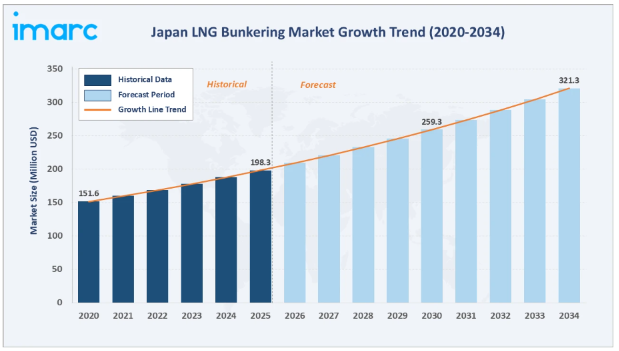
The Japan LNG bunkering market reached USD 198.3 Million in 2025 and is projected to reach USD 321.3 Million by 2034, exhibiting a CAGR of 5.51% during 2026-2034. The rapid expansion of Japan’s LNG-fueled vessel fleet and sustained government subsidies for LNG bunkering port infrastructure are the primary growth catalysts. NYK plans to construct 20 LNG-powered car carriers, including the newly announced vessel, at shipyards in Japan and overseas by 2028. This fleet expansion is expected to increase marine LNG consumption and strengthen demand for dependable bunkering services at Japanese ports. The container fleet leads end users at 34.8%, and the Kanto region accounts for the largest regional share at 26.7%.
The Japan LNG bunkering market demonstrated steady growth, rising from USD 151.6 Million in 2020 to USD 198.3 Million in 2025, underpinned by Japan’s pioneering role in LNG bunkering technology and the progressive build-out of ship-to-ship (STS), truck-to-ship (TTS), and port-to-ship (PTS) bunkering infrastructure at key ports. The market is projected to reach USD 259.3 Million by 2030 and USD 321.3 Million by 2034.
Container fleet end users grow at ~5.8% CAGR as global container shipping lines accelerate LNG-fueled vessel deployment to meet greenhouse gas reduction targets. Ferries and OSV grow at ~6.2% CAGR, the fastest end-user segment. Kanto region leads regional growth at ~6.7% CAGR through the Tokyo Bay bunkering hub expansion.
The Japan LNG bunkering market encompasses the infrastructure, services, and logistics associated with supplying LNG as fuel to ships at Japan’s maritime ports. Bunkering operations span ship-to-ship (STS) transfer using dedicated LNG bunker vessels, truck-to-ship (TTS) delivery using cryogenic LNG tank trucks for smaller vessels, and port-to-ship (PTS) transfer from fixed terminal installations. Macroeconomic factors include expanding maritime trade, fleet modernization, and rising investment in port and LNG supply infrastructure. Stricter emission regulations, fuel-price dynamics, and Japan’s broader decarbonization and energy-security policies are also encouraging the adoption of LNG as a marine fuel.
Market Drivers
• Expanding LNG-Fueled Vessel Fleet: NYK Line plans to launch 20 LNG-fueled car carriers by 2028, while Mitsui O.S.K. Lines, Ltd. is targeting 90 LNG-fueled vessels by 2030. These ambitious fleet conversion programs, supported by Japan’s major automotive manufacturers, create predictable, long-term LNG bunkering demand that justifies significant investment in dedicated bunkering infrastructure and bunker vessel capacity.
• Government Subsidies and Green Shipping Strategy Support: Japan’s Green Transformation (GX) policy framework designates LNG as a primary transition fuel for the marine sector, providing financial incentives for both LNG-fueled vessel construction and LNG bunkering infrastructure development. The Green Shipping Corridor initiative, promoting zero-emission shipping routes connecting Japan’s major ports, also supports LNG bunkering investment as a near-term decarbonization pathway.
• Long-Term LNG Supply Contract Security: Long-term LNG supply contracts ensure stable fuel availability and reduce exposure to spot-market price volatility. Greater supply and pricing certainty allows shipping companies and bunkering operators to plan fleet conversions and infrastructure investments confidently. These agreements also encourage the expansion of LNG storage terminals, bunker vessels, and port-based refueling facilities.
Market Restraints
• High Infrastructure Capital Cost and Port Installation Complexity: Establishing dedicated LNG bunkering infrastructure requires significant capital investment, including cryogenic bunkering vessels, port LNG storage tank installations, safety exclusion zone management, and specialized crew training. Port operators must also manage complex safety protocols for simultaneous LNG bunkering and cargo operations, which adds operational complexity and potential throughput constraints at busy multipurpose ports.
• Competition from Low-Sulfur Fuel Oil (LSFO) and Marine Gas Oil (MGO): While LNG offers superior environmental performance for NOx and SOx emissions, LSFO and MGO provide cap compliance without requiring vessel modifications or dedicated bunkering infrastructure. Many existing vessel operators have opted for LSFO as a lower-cost, lower-complexity compliance solution, particularly for vessels with a remaining service life of less than 10 years that cannot justify the capital cost of LNG dual-fuel conversion. LSFO and MGO availability at virtually all Japanese ports provides a competitive baseline that LNG must outperform on total cost of ownership to achieve mainstream adoption.
[Scope of the Report]
End Users Covered
Tanker Fleet, Container Fleet, Bulk and General Cargo Fleet, Ferries and OSV, Others
Regions Covered
Kanto Region, Kansai/Kinki Region, Central/Chubu Region, Kyushu-Okinawa Region, Tohoku Region, Chugoku Region, Hokkaido Region, Shikoku Region
Companies Covered
NYK Line, Mitsui O.S.K. Lines, Toyota Tsusho Corporation, Kawasaki Heavy Industries, Ltd., etc.
1 Preface
2 Scope and Methodology
2.1 Objectives of the Study
2.2 Stakeholders
2.3 Data Sources
2.3.1 Primary Sources
2.3.2 Secondary Sources
2.4 Market Estimation
2.4.1 Bottom-Up Approach
2.4.2 Top-Down Approach
2.5 Forecasting Methodology
3 Executive Summary
4 Japan LNG Bunkering Market – Introduction
4.1 Overview
4.2 Market Dynamics
4.3 Industry Trends
4.4 Competitive Intelligence
5 Japan LNG Bunkering Market Landscape
5.1 Historical and Current Market Trends (2020-2025)
5.2 Market Forecast (2026-2034)
6 Japan LNG Bunkering Market – Breakup by End User
6.1 Tanker Fleet
6.1.1 Overview
6.1.2 Historical and Current Market Trends (2020-2025)
6.2.3 Market Forecast (2026-2034)
6.2 Container Fleet
6.2.1 Overview
6.2.2 Historical and Current Market Trends (2020-2025)
6.2.3 Market Forecast (2026-2034)
6.3 Bulk and General Cargo Fleet
6.3.1 Overview
6.3.2 Historical and Current Market Trends (2020-2025)
6.3.3 Market Forecast (2026-2034)
6.4 Ferries and OSV
6.4.1 Overview
6.4.2 Historical and Current Market Trends (2020-2025)
6.4.3 Market Forecast (2026-2034)
6.5 Others
6.5.1 Historical and Current Market Trends (2020-2025)
6.5.2 Market Forecast (2026-2034)
7 Japan LNG Bunkering Market – Breakup by Region
7.1 Kanto Region
7.1.1 Overview
7.1.2 Historical and Current Market Trends (2020-2025)
7.1.3 Market Breakup by End User
7.1.4 Key Players
7.1.5 Market Forecast (2026-2034)
7.2 Kansai/Kinki Region
7.2.1 Overview
7.2.2 Historical and Current Market Trends (2020-2025)
7.2.3 Market Breakup by End User
7.2.4 Key Players
7.2.5 Market Forecast (2026-2034)
7.3 Central/ Chubu Region
7.3.1 Overview
7.3.2 Historical and Current Market Trends (2020-2025)
7.3.3 Market Breakup by End User
7.3.4 Key Players
7.3.5 Market Forecast (2026-2034)
7.4 Kyushu-Okinawa Region
7.4.1 Overview
7.4.2 Historical and Current Market Trends (2020-2025)
7.4.3 Market Breakup by End User
7.4.4 Key Players
7.4.5 Market Forecast (2026-2034)
7.5 Tohoku Region
7.5.1 Overview
7.5.2 Historical and Current Market Trends (2020-2025)
7.5.3 Market Breakup by End User
7.5.4 Key Players
7.5.5 Market Forecast (2026-2034)
7.6 Chugoku Region
7.6.1 Overview
7.6.2 Historical and Current Market Trends (2020-2025)
7.6.3 Market Breakup by End User
7.6.4 Key Players
7.6.5 Market Forecast (2026-2034)
7.7 Hokkaido Region
7.7.1 Overview
7.7.2 Historical and Current Market Trends (2020-2025)
7.7.3 Market Breakup by End User
7.7.4 Key Players
7.7.5 Market Forecast (2026-2034)
7.8 Shikoku Region
7.8.1 Overview
7.8.2 Historical and Current Market Trends (2020-2025)
7.8.3 Market Breakup by End User
7.8.4 Key Players
7.8.5 Market Forecast (2026-2034)
8 Japan LNG Bunkering Market – Competitive Landscape
8.1 Overview
8.2 Market Structure
8.3 Market Player Positioning
8.4 Top Winning Strategies
8.5 Competitive Dashboard
8.6 Company Evaluation Quadrant
9 Profiles of Key Players
9.1 NYK Line
9.1.1 Business Overview
9.1.2 Products Offered
9.1.3 Business Strategies
9.1.4 SWOT Analysis
9.1.5 Major News and Events
9.2 Mitsui O.S.K. Lines
9.2.1 Business Overview
9.2.2 Products Offered
9.2.3 Business Strategies
9.2.4 SWOT Analysis
9.2.5 Major News and Events
9.3 Toyota Tsusho Corporation
9.3.1 Business Overview
9.3.2 Products Offered
9.3.3 Business Strategies
9.3.4 SWOT Analysis
9.3.5 Major News and Events
9.4 Kawasaki Heavy Industries, Ltd.
9.4.1 Business Overview
9.4.2 Products Offered
9.4.3 Business Strategies
9.4.4 SWOT Analysis
9.4.5 Major News and Events
10 Japan LNG Bunkering Market – Industry Analysis
10.1 Drivers, Restraints, and Opportunities
10.1.1 Overview
10.1.2 Drivers
10.1.3 Restraints
10.1.4 Opportunities
10.2 Porters Five Forces Analysis
10.2.1 Overview
10.2.2 Bargaining Power of Buyers
10.2.3 Bargaining Power of Suppliers
10.2.4 Degree of Competition
10.2.5 Threat of New Entrants
10.2.6 Threat of Substitutes
10.3 Value Chain Analysis
11 Appendix
 ワックスの日本市場(2026年~2034年) The Japan wax market size reached USD 666.1 Million in 2025 and is projected to reach USD 901.6 Million by 2034, exhibiting a CAGR of 3.32% during 2026-2034. Growing demand from cosmetics, packaging, and candle manufacturing sectors, rising preference for sustainable bio-based wax alternatives, and …
- 靴下の日本市場(2026年~2034年) The Japan hosiery market size was valued at USD 2.57 Billion in 2025 and is projected to reach USD 3.3 Billion by 2034, growing at a compound annual growth rate of 2.90% from 2026-2034. The Japan hosiery market is propelled by enduring cultural preferences for modest, polished dressing, complemented…
- 日本のメンタルヘルス市場(2026年~2034年) The Japan mental health market grew from USD 27.5 Billion in 2025 to USD 28.3 Billion in 2026 and is projected to reach USD 37.6 Billion by 2034, exhibiting a compound annual growth rate of 3.60% during 2026-2034. The market is driven by the growing incidence of anxiety, depression, and stress disor…
- 肉の日本市場(2026年~2034年) The Japan meat market reached USD 37.15 Billion in 2025 and is projected to reach USD 48.64 Billion by 2034, growing at a CAGR of 2.95% during 2026-2034. The market is driven by steady demand for high-quality protein, rising consumption of processed and ready-to-cook meat products, and strong foodse…
- 海藻の日本市場(2026年~2034年) Japan seaweed market size reached USD 571.2 Million in 2025. Looking forward, IMARC Group expects the market to reach USD 1,036.1 Million by 2034, exhibiting a growth rate (CAGR) of 6.84% during 2026-2034. The rising consumer inclination towards plant-based diets and alternative protein sources, alo…